Surviving the Polar Vortex

imagesR5MFAI7EAs we take the polar bear plunge into the depths of winter, not only do we have to be concerned about keeping our bodies warm, but we also need to take precautions for our homes.  Indiana homes are especially susceptible to the cold weather with snowfalls along with periods of melting and then freezing, and then melting and then freezing….etc.  This freezing and thawing can inflict considerable damage to our homes.

So, here are some tips and steps that you can take to protect your home from these periods of freezing and melting temperatures.

  • Keep sidewalks and entrances to your home free from snow and ice.
  • Watch for ice dams near gutter downspouts. Keep gutters free of leaves and debris so melting snow and ice can flow freely. Ice dams can cause water to build up and seep into your house.
  • Keep the house heated to a minimum of 65 degrees. The temperature inside the walls where the pipes are located is substantially colder than the walls themselves. A temperature lower than 65 degrees will not keep the inside walls from freezing.
  • Identify the location for the main water shutoff in your home. Find out how it works in case you have to use it.
  • Open hot and cold faucets enough to let them drip slowly. Keeping water moving within the pipes will prevent freezing.untitled
  • If you own a swimming pool and temperatures are expected to dip below freezing, run the pool pump at night to keep the water flowing through the pipes.
  • If you haven’t already, make sure all hoses are disconnected from outside spigots.
  • If your garage is attached to your house, keep the garage doors closed. The door leading to the house is probably not as well-insulated as an exterior door.
  • If ice forms on tree limbs, watch for dead, damaged or dangerous branches that could break and fall because of ice, snow or wind and damage your house, a car, or injure someone walking near your property.
  • If you use fireplaces, wood stoves and electric heaters, watch them closely and make sure they are working properly.
  • Remember to close the flue in your fireplace when you’re not using it.
  • If you have to leave your home on a trip, ask a neighbor to check the house regularly. If there is a problem with frozen pipes or water leakage, attending to it quickly could mean far less damage.
  • If you plan to be away for an extended period of time (or if temperatures are expected to remain below freezing), have the water system, including pool plumbing, have the water system drained by a professional to keep pipes from freezing or bursting.
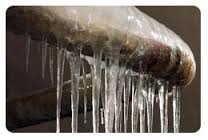
imagesY2XG7Y0UIf the worst has occurred and you have a problem with your home related to the winter weather, here are some other helpful suggestions.

  • If you discover that pipes are frozen, don’t wait for them to burst. Take measures to thaw them immediately, or call a plumber for assistance.
  • If your pipes burst, first turn off the water and then mop up spills. You don’t want the water to do more damage than it already has.
  • Call your agent or company as soon as you can. An insurance adjuster doesn’t need to see the spill before you take action. However, he or she will want to inspect any damaged items.
  • Make temporary repairs and take other steps to protect your property from further damage. Remove any carpet or furniture that can be further damaged from seepage.
  • Make a list of the damaged articles.
  • Save the receipts for what you spend—including additional living expenses if you must leave your home until repairs are completed—and submit them to your insurance company for reimbursement.

A standard homeowner’s policies will cover most of the kinds of damage that result from a freeze. For example, if house pipes freeze and burst or if ice forms in gutters and causes water to back up under roof shingles and seep into the house. You would also be covered if the weight of snow or ice damages your house.

However, most policies do not cover backups in sewers and drains or flood damage, which can also happen in winter. To be covered for flooding, you need a policy from the National Flood Insurance Program, while coverage for sewers and drains is generally offered as an endorsement to a standard homeowner’s insurance policy.

If your home suffers water damage, it is important to make sure that it is properly dried and repaired to prevent any potential problem with mold. Remember, mold cannot survive without moisture.

Check with your agent or company so you’ll be sure what your policy covers.

Source Insurance Information Institute

When Optimisim is a Negative

“It won’t happen to me is not a good insurance program”

It’s quite amazing how many optimistsglass-half-full-233x300 that I run into on a daily basis. I too am a “glass half full” person, so I truly understand the optimistic mindset. While I consider myself to be a positive person I cannot hold a candle to some of the idealistic thinkers that cross my path. Recently I’ve been putting these Utopian-minded folks into 3 categories.

The Immortals – This group is the most sanguine. They are a confident group that thinks that they cannot die. They are usually young and believe that their youth and positive buoyant attitude will keep death at bay. They go about their day to day activities on cloud nine ignoring pessimistic thoughts such as death, and responsibilities.

Unfortunately “The Immortals” do die, and many times way too young. Sometimes they leave behind a family with both emotional and financial voids. They leave behind mortgages, motorcycle payments, car payments, children, spouses, and extra expenses related to their funeral.

The Conscientious Optimist – This group of optimists are so meticulous that an accident could never happen to them. They are superb drivers, their homes are danger free zones and they never take risks –Never! When they drive they are able to look 3 and 4 moves ahead of everyone else and they can actually read the minds of other drivers. These clairvoyant powers keep them out of the path of drunk drivers and they are able to spot deer before they look into the headlights.

Unfortunately just as Superman’s weakness was kryptonite, even The Conscientious Optimist is susceptible to accidents. A car sometimes appears out of nowhere, someone hits their vehicle when it’s parked in a parking lot, or they only looked away for a second and that’s when the accident happened.

The Optimistic Procrastinator – Normally procrastination is associated as a negative word, but I’ve come to realize that Procrastinators are actually very positive people. They believe beat_procrastinationthat they can wait until the very last minute to take care of a duty or a task. Some of their most often used words are, “I meant to”, or “I was just getting ready to do that”, or “there’s plenty of time to do that later”

Unfortunately for the procrastinator his optimistic view of time often times runs out. His “meant to” turns into never did, and his “I was just getting ready to do that” turns into never got it done. The thing the optimistic procrastinator doesn’t realize is that when time runs out, his good intentions aren’t worth a hill of beans. He was derelict in his duties and responsibilities in spite of his good intentions.

pic-lhb-familyWe optimists are funny people. We really do see the glass as half full. But we also need to be aware of a balancing truth. We are not immortal, we do not have a magic force field around us protecting us from accidents, and we are not promised tomorrow.

So why not rather be an optimist that is prepared for the future? Live life to the fullest, but be prepared in case it’s your last day. Be a conscientious person that avoids all accidents, but have a plan in case the unexpected happens. Today, stop putting off those “meant to do” items and get them done today.

Brian Bragg owns and operates Bragg Insurance Agency and can be emailed at brian@bragginsurance.com

Spring Storms Can Bring Scam Artists

Watch for Scams after a Storm

Concerned WomanAs winter winds down and we draw closer to Spring you will begin to hear the importance of being prepared for the Springtime storms. As everyone knows we are at a greater risk for Tornados and serious wind and hail storms in the Spring and Fall.

These storms can turn your home and your life upside down. If your home is damaged in a storm you are eager to get your home repaired as quickly as possible so that you can get your life back to normal. It’s during this time of eagerness that you can become victim to another “natural disaster”, a scam artist.

Most contractors are reputable business people. But each year, there are a few dishonest ones who chase storms from state to state. They will try to convince you that you have hail or other damage and that you need a new roof when in fact you really don’t. They’ll ask to be hired for the work, explaining that your insurance company will pay for the repairs.th7JGJ1NLC

Most homeowner’s insurance policies will cover damage caused by hail and windstorms, but they will not cover the cost to replace a roof or siding when no damage has occurred. It is always recommended that you obtain a second and even a third opinion before starting any contract work.

What you can do?

If you’re beginning to repair or rebuild after a storm, or even if you are just planning a home improvement project, keep these tips, recommended by the Federal FEMAEmergency Management Agency, in mind for choosing contractors wisely:
• Get more than one estimate.
• Don’t be pushed into signing a contract right away.
• Get everything in writing. Cost, work to be done, time schedules, guarantees, payment schedules and other expectations should be detailed.
• Check references before deciding which contractor to choose.
• Never sign a contract with blanks.
• Don’t pay a contractor in full until the work is complete.
• Check with county or city licensing authorities to see if the contractor is licensed in your jurisdiction, as well as checking for complaints with their regional Better Business Bureau.

Contact your local independent agent.

If you need suggestions about who to hire or how to repair your home after a storm, your local independent agent can help you contact an insurance claims adjuster. Most insurance carriers have professional claims adjusters who are trained to assess your property, identify storm damage and prepare an estimate for proper repair. They can also provide recommendations for reliable, licensed contractors in your area—although the final choice of contractor is always yours.

2014 Insurance Planning

Greeting the New Year is one of my favorite events. Beautiful-Happy-New-Year-2014-HD-Wallpapers-by-techblogstop-1It’s a time when I can reflect back at what has transpired over the past 12 months, and set goals and plans for what I hope to accomplish over the year. It’s a time when I can free myself of the past year’s failures and shortcomings, while I celebrate my accomplishments and prepare to be my best in the New Year.

Some people will resolve to lose weight or quit smoking in the New Year. I would imagine that a lot will sit down at the kitchen table with pen and paper in hand to do some financial goal planning. You’re planning to pay off that pesky credit card, or maybe you’re planning on putting in that swimming pool that you’ve always wanted.

Insurance AgentWith this in mind, let me suggest that the New Year is also an excellent time to review all of your insurance needs with your insurance agent. Insurance is not a “set it and forget it” financial product. It’s a financial product that needs to be continually maintained. As our lives change so do our insurance needs.

As you probably know, there are many changes imagesMAO8Q7F8taking place in insurance right now, and not just in health insurance, but also in home and auto. Premium rates are increasing and coverages are decreasing. You’ve probably noticed the increasing premiums, but did you know that your coverages may not be as good as they once were?

I thought that I was covered is not an insurance program. Make an annual insurance review part of your new year’s financial strategy. You will be glad that you did.


Has Your Deductible Changed Without Your Knowledge?

For the past several years homeowner’s insurance companies in Indiana have been losing money, primarily because of wind and hail claims. Storm patterns in recent years have pelted the Midwest with wind and hail related claims that reach into the $ billions. In fact many insurance companies are paying out 2 dollars in claims, for every dollar they receive in premium.Hail-damage-house-OK-6-2011-lg

This has been the primary reason the industry has seen such an increase in homeowners insurance premiums over the past few years. While this trend is not likely to end any time soon, some insurance companies are also changing the way they pay out claims.

Traditionally a homeowner’s policy has a dollar amount named as the deductible. That amount is subtracted from the amount of the claim. For example, if the policy has a $1,000 deductible and there is a $5,000 claim, the insurance company would pay out $4,000.

However there is a trend in the industry that has some companies changing their deductibles from a dollar amount to a percentage, especially if the claim has been caused by wind or hail.

Hand over your moneyI recently spoke to a married couple who had damage to their roof caused by the outbreak of tornadoes we experienced in the month of November. They called their insurance company to file a claim, and discovered that their deductible for a wind claim is 10% of their dwelling value. Their dwelling value is $360,000 which made their deductible $36,000. Needless to say they ended up having to pay for the repairs to their roof out of their own pocket.

Did you catch that? Their deductible was $36,000 for wind and hail damages!

Unfortunately many other companies are following suit. Some very large and well-known insurance companies are changing their wind and hail deductibles to a % and most of their clients are unaware of the change. Often times clients are only notified of this change within the mountain of paperwork they receive in the mail from the company at the policies renewal.

Let’s face it; most people do not have the time to sift through that much paperwork. They file it away and assume that the coverages have remained the same.

The example given above of a 10% deductible is the most extreme case that I have seen. More frequently I am seeing wind and hail damage deductibles changing from a dollar amount to 1% or 2% of the dwelling coverage. 1% or 2% of the dwelling is still a significant amount of money to pay out of pocket at the stressful time of a claim.take action

Protect yourself.

1. Review your documents. Take the time to review the documents when you receive information in the mail from your insurance company. If you do not understand the language or have questions, take the policy to your agent and have them explain the coverages.

annual review2. Insist on an annual review. Your agent should be sitting down with you on an annual basis to review your coverages and to answer your questions. There are too many changes taking place in the homeowner’s insurance arena right now to ignore the paperwork and hope for the best.

3. Educate yourself. Too often times I hear people say that they paid their premium so the assumed everything was OK. Don’t turn a blind eye to your insurance coverages. Insurance is expensive so you should do you best to make sure that you understand what you are paying for.

Replacement Value or Actual Cash Value

Do you have Replacement Value or Actual Cash Value? This is an important question that needs to asked when determining which insurance program is right for you.

ConfusionReplacement Value Insurance means that if your covered item is destroyed you will be paid the amount of money it takes to replace that item with a brand new item. There are a few caveats in each policy and you must subtract your deductible, but this is a good definition of Replacement Value.

Actual Cash Value Insurance (ACV) means that if your covered item is destroyed you will be paid the value of that item at the time of the occurrence. If your item is 10 years old the item will be depreciated accordingly and you will be paid the cash value of that item minus your deductible.

Here are two examples.

Your roof blows off of your house in a bad storm. You get an estimate of $15,000 to replace your roof.Limestone Tornado Damage

If you have Replacement Value Insurance with a $1,000 deductible the insurance company would pay the roofing contractor $14,000 and you would pay $1,000, the amount of your deductible.

If you have ACV with a $1,000 deductible the insurance company would then do some calculations to determine the value of your roof at the time of the occurrence. If your roof is 8 years old, they would depreciate the value of your roof by 8 years. They may determine that the cash value of your roof to be $11,000. The insurance company would then pay the roofing contractor $10,000 ($11,000 minus your deductible of $1,000), and you would pay the roofing contractor the remaining $5,000.

Here’s another example

Missing RoofIn that same scenario of the roof blowing off of your home, you have nearly all of your personal property damaged by rain water, hail damage, and wind.

If you have Replacement Value Insurance on your personal property the insurance company would calculate how much it would cost to replace the damaged personal property with new personal property of the same kind. If they determine that it is $100,000, you would be paid out that amount to replace your personal property. In this case the deductible was already paid through the roofing contractor.

If you have ACV on your personal propertyConcerned Woman the insurance company would then do some calculations to determine the cash value of your personal property at the time of the occurrence. You may only get $200 for your 10 year old couch, even though a new couch may cost $1,200. They may determine that your personal property had a cash value of $25,000 at the time of the occurrence. You would be paid out that amount to replace your personal property. Your deductible was already paid through the roofing contractor.

Summarizing these 2 example; if you had Replacement Value Insurance your insurance company would have paid out $114,000 (replacement of the roof and your personal property) and you would have had to pay out $1,000 (the amount of your deductible); and if you had ACV your insurance company would have paid out $35,000 (the ACV of the roof and your personal property minus your deductible) and you would have had to pay out $80,000 to replace your roof and personal property.

new roofReplacement Value Insurance cost about 10% more than ACV and there are some situation where ACV is called for. Some risks may not be eligible for Replacement Value Insurance because of the condition of the property, or the nature of the risk.

There are changes taking place in the insurance industry right now that you need to be aware of.  Some companies are changing the way that they pay out claims from what they may have done in the past. I am seeing deductibles increasing and policies that once had Replacement Value Insurance getting changed to ACV. Many HO3 polices have Replacement Value on the home but ACV on the personal property. Do you know what you have? logo3696786_mdIf you are unsure, contact your agent right away.

You can also contact Bragg Insurance Agency at 317-758-5828 for a free no obligation review of any of your insurance policies.